
GLOBAL PARLIAMENTARY FORUM BANGKOK - Cameroon Delegation Pushes for Stronger Laws
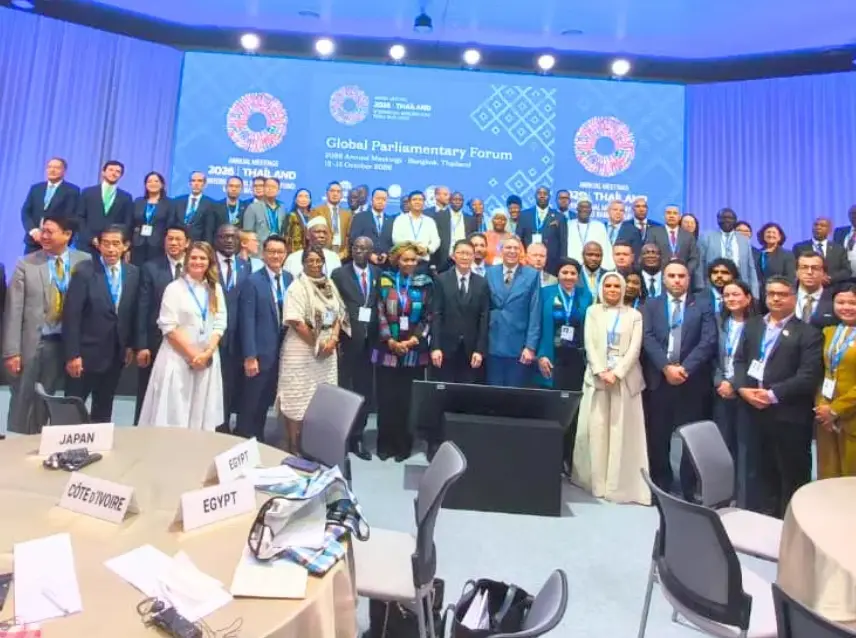
In Bangkok, Cameroon’s parliamentary delegation examines telecommunications policy, legislative oversight and the legal foundations needed to translate government decisions into effective action.
A delegation of Cameroonian parliamentarians is using the 2026 Annual Meetings of the International Monetary Fund (IMF) and the World Bank Group in Bangkok, Thailand, to engage in discussions on public policy, legislative frameworks and the effective implementation of government decisions.
The meetings, took place from October 12 to 18, brought together policymakers, government officials, financial experts and development partners to examine global economic challenges and strategies for sustainable development.
The Cameroonian delegation comprises Hon. Njingum Musa Mbutoh, Member of Parliament for Ngoketunjia North Constituency in the North West Region and First Quaestor of the National Assembly; Hon. Pauline Ndoumou, Quaestor of the National Assembly; Hon. Jean Jacques Zam; and Hon. Alyoum Fadil.
During the deliberations, attention turned to Cameroon’s policy and legislative environment, notably matters relating to the Ministry of Posts and Telecommunications and legislation adopted by the National Assembly. The exchanges highlighted the need for stronger alignment between government policy, legislative action and administrative implementation.
A central issue was the importance of ensuring that government proposals and administrative circulars requiring legislative backing are translated into appropriate legal instruments. Such an approach, the discussions underscored, would strengthen legal certainty, clarify institutional responsibilities and promote accountability in public administration.
The exchanges also brought into focus the broader role of Parliament in scrutinising government action and ensuring that public policies are implemented within established legal frameworks. Effective governance, beyond the adoption of laws and policy decisions, depends on sound implementation mechanisms, institutional coordination and compliance with the law.
Cameroon’s participation in the international gathering provides an opportunity to contribute national perspectives to discussions on governance, institutional effectiveness and development policy. The engagement also places legislative oversight within the broader debate on the institutional conditions necessary for effective public-sector management and sustainable economic progress.
As the Annual Meetings draw to a close, the issues raised underscore a fundamental principle of governance: policy decisions achieve their intended impact when they are supported by clear legal frameworks and translated into effective action.
Comments(0)
Loading comments…